
Intersectionality and How It Helps Us Recognize Violence
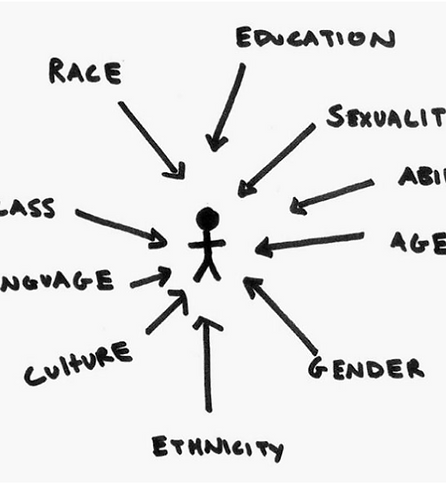
How does systemic discrimination emerge, and how can it be challenged? What social, economic, and cultural factors increase the risk of violence for some women? These questions are addressed by an intersectional lens, which sees women not simply as half of humanity, but as a multitude of intersecting identities and lived experiences.
What is intersectionality?
Intersectionality is a concept in social theory that examines how different forms of discrimination intersect, reinforce one another, and shape a person’s interaction with society. This lens makes it possible to identify systems of oppression based on different characteristics, such as sexism based on gender or racism based on skin color. The more stigmatized characteristics a person has, the more strongly these systems of oppression affect them.
Intersectionality allows us to take a holistic view of individual experiences and to understand how privilege and discrimination arise, where inequality takes root, and where violence begins. To have an intersectional perspective means seeing people as a tightly interwoven combination of traits and identities that come together to form each person’s unique experience. After all, we are not two-dimensional characters but individuals with many traits and the circumstances that shaped us. Most of these characteristics are not chosen, yet society responds to them with varying degrees of tolerance.
As a result, some identities in society are labeled as deficiencies, while others are considered normal or desirable. Stereotypes and harmful biases shape this dynamic. Condemnation of certain traits leads to discrimination, which, in turn, produces inequality, with more privileged groups having greater power and opportunities. This creates fertile ground for systemic violence against less privileged people.
On what grounds can people be discriminated against?
In reality, discrimination can occur based on anything that does not conform to the dominant, desirable norms in a given society. Some such characteristics include:
-
ethnic background
-
age
-
sexual orientation
-
family status
-
gender identity
-
skin color
-
health status
A person can be discriminated against on several grounds at the same time. For example, a woman may face misogyny due to gender bias; a trans woman is additionally vulnerable to transphobia, and a trans woman with a disability also to ableism.
How does this help us understand violence against women?
Intersectionality allows us to see women not as an abstract, homogeneous group detached from reality, but as a collection of complex and multifaceted individual experiences. Thanks to this, we can recognize what makes us vulnerable and explain why some women face violence more often than others. As a result, we are better able to understand how to address specific forms of violence more effectively.
Throughout their lives, nearly all women encounter misogyny in various spheres, from everyday life to career development. At the same time, some women experience additional oppression, both from society at large and from other women. Some may be treated as “second-class” people, viewed as inferior, or not recognized as women at all.
For example, lesbians may face homophobia in addition to misogyny and struggle to fit into a heteronormative society. If a lesbian woman also has a mental health condition, this places her within yet another system of oppression that she must contend with throughout her life. When these characteristics are considered together, even more biases and dangers become visible. Homosexuality is still sometimes associated with mental illness, women are often stereotyped as inherently “unstable,” and female homosexuality is erased or subjected to violent attempts at “correction.”
It is crucial to understand that gender-based violence is not only physical, but can also be psychological, economic, or sexual. For example, in addition to the risk of sexual violence, a lesbian or bisexual woman may be subjected to so-called corrective rape. Women in the military may face prejudice and harassment during service, as well as difficulties with reintegration into civilian life. Black women may be exposed to racist remarks and experience abuse more frequently. Older women may face barriers to employment and ageist prejudice in the workplace, in society, or within their own families.
The more stigmatized characteristics a person has, the greater the pressure society exerts on them, creating additional obstacles and dangers and deepening marginalization. This, in turn, increases vulnerability to various forms of violence.
How can intersectionality be practiced?
-
Recognize your privileges.
Privileges (such as financial security or belonging to a majority group) often improve one’s position in society. They can be difficult to notice, as we tend to perceive our privileges as the default setting. This can make us less sensitive to those whose “settings” are different. It is therefore important to reflect on which of our characteristics are more or less privileged and how this shapes our lives.
-
Learn about other people’s experiences and engage in self-education.
Once we recognize that we are all different, it is important not to dismiss other people’s experiences. For example, if you are a heterosexual person and same-sex relationships seem strange or unfamiliar to you, try first to learn about them through reliable sources or talk to real queer people before drawing conclusions or passing judgment.
-
Practice inclusivity and solidarity.
Whenever possible, it is important to help less privileged people have equal access to opportunities. At the very least, challenge stereotypes in yourself and others, avoid slurs (words that insult someone based on certain characteristics, such as sexual orientation, ethnicity, gender identity, etc.), and call out hate speech and prejudice.
It is very important to remember that our strength lies in solidarity. Women should unite, listen to one another, and understand both shared and individual needs in order to fight for their rights together. Sensitivity, empathy, and patience are what will help gradually break the cycle of violence, step by step.